Creativity – A 21st Century Skill
Creativity – A 21st Century Skill
Creativity is the ability to come up with ideas that are new and useful. It is not just about art or imagination, but about solving problems in different and meaningful ways. Researchers often describe creativity as thinking beyond the obvious and finding connections that others may not see. In today’s world, creativity is no longer optional. It has become an essential skill because the challenges we face are complex and constantly changing.
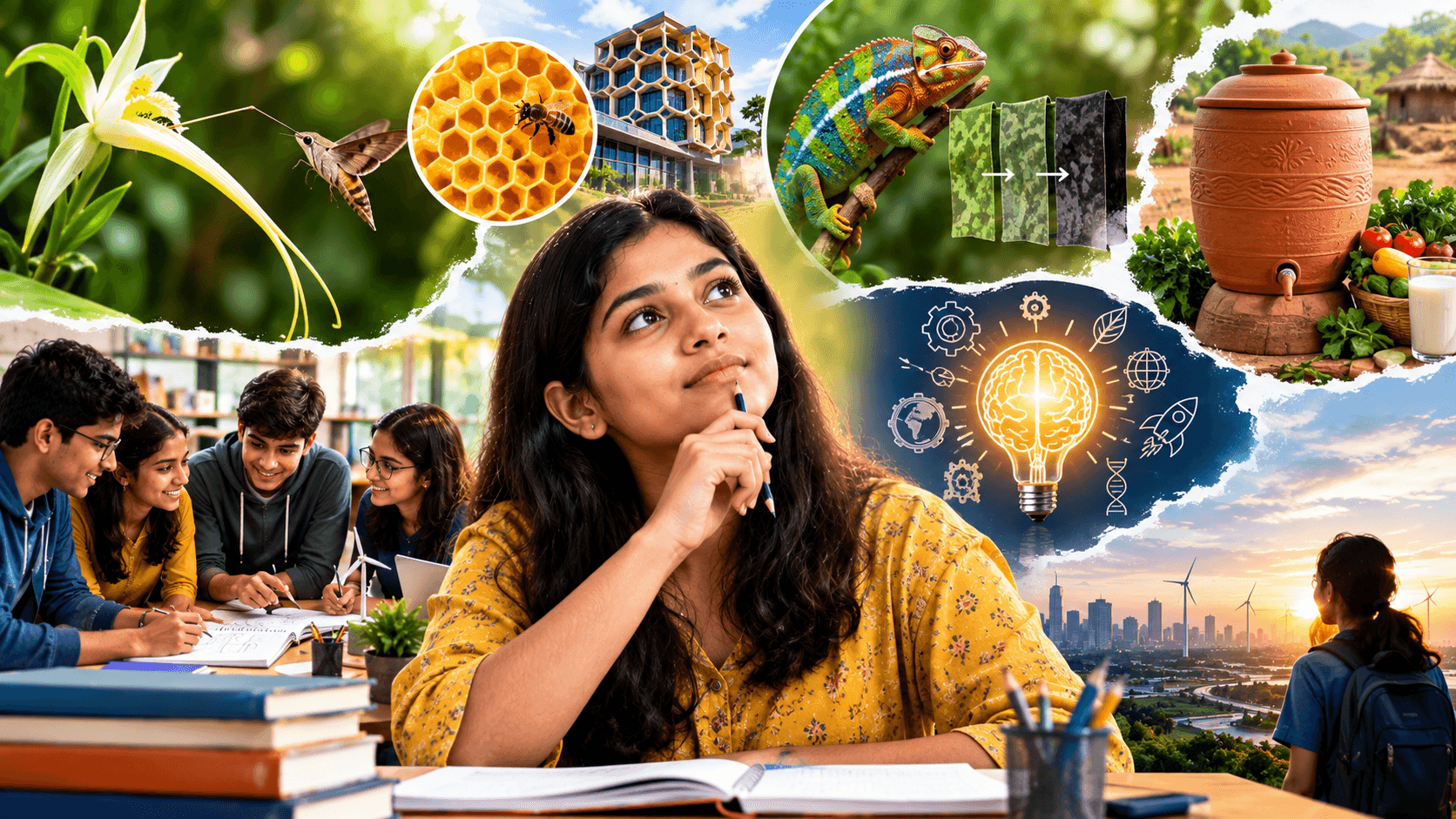
One of the best spaces to observe creativity is in nature. Over millions of years, nature has developed solutions that are both efficient and beautiful. Flowers, for example, show incredible creativity in how they attract pollinators. A well-known case is the Angraecum sesquipedale, sometimes called Darwin’s orchid. This flower has a very long tube that stores nectar deep inside.
When Charles Darwin first studied it, he predicted that there must be a moth with a very long proboscis to reach the nectar. Years later, such a moth was discovered. Some related species have floral tubes approaching extreme lengths, showing how nature “designs” systems where both the flower and the insect evolve together. This kind of natural creativity is not random; it is purposeful and refined over time.
Humans have learned a great deal by observing nature. This approach, known as biomimicry, has led to many innovations. For instance, the structure of termite mounds has inspired buildings that stay cool without heavy air conditioning. Similarly, the arrangement of sunflower seeds has influenced efficient designs in solar panels. These examples show that creativity is often about observing carefully and applying ideas in new contexts. Many successful innovations come from combining ideas from different fields rather than inventing something completely from scratch.
One such instance where nature has been used as an influence is the use of honeycomb structures in the architecture and aerospace industries. These are favoured for their strength and maximization of volume in minimal space owing to their interlocking hexagonal design.
Similarly, chameleon camouflage technology is being developed to mimic the natural ability of chameleons to change color in response to their environment. This technology, known as Self-Adaptive Photochromism (SAP), allows materials to change color based on light conditions. These materials, when applied to clothing and equipment, make them appear "effectively invisible" when in a dark environment, making them effective for military camouflage and other applications.
A simple example of innovation and design in the Indian context is the Mitticool refrigerator, created by Mansukhbhai Prajapati in Gujarat. This refrigerator is made entirely from clay and does not use electricity. It works on a natural cooling process where water slowly evaporates from the clay surface. It can store vegetables, fruits, and even milk for a few days. The idea is simple but very creative, designed especially for rural areas. It is also eco-friendly and affordable, making it accessible to many people.
Creativity also plays a very important role in education. Traditional education systems often focus on memorizing facts and finding the “right” answer. However, real learning happens when students are encouraged to ask questions, explore different possibilities, and think independently. Studies in education show that students who engage in creative activities such as storytelling and design develop better critical thinking skills. In engineering education, for example, students who work on real-world projects and collaborate with others tend to produce more innovative solutions. Creativity helps learners become active thinkers rather than passive receivers of information and executors of routine tasks.
The connection between creativity and innovation is very strong. Creativity is about generating ideas, while innovation is about turning those ideas into real solutions. Many companies today look for people who can think creatively because they need new ways to solve problems and stay competitive. Whether it is developing new technologies, improving healthcare, or addressing environmental issues, creative thinking is at the heart of progress. Without creativity, innovation cannot exist.
This is why creativity is considered a key 21st century skill. The world is changing quickly due to technology, globalization, and new challenges such as climate change. Many routine jobs are being automated, which means that human skills like creativity, critical thinking, and adaptability are becoming more valuable. People need to be able to think in flexible ways, learn continuously, and come up with new ideas. Creativity allows individuals not just to adapt to change, but to shape the future.
Creativity – A 21st Century Skill
Creativity is the ability to come up with ideas that are new and useful. It is not just about art or imagination, but about solving problems in different and meaningful ways. Researchers often describe creativity as thinking beyond the obvious and finding connections that others may not see. In today’s world, creativity is no longer optional. It has become an essential skill because the challenges we face are complex and constantly changing.
One of the best spaces to observe creativity is in nature. Over millions of years, nature has developed solutions that are both efficient and beautiful. Flowers, for example, show incredible creativity in how they attract pollinators. A well-known case is the Angraecum sesquipedale, sometimes called Darwin’s orchid. This flower has a very long tube that stores nectar deep inside.
When Charles Darwin first studied it, he predicted that there must be a moth with a very long proboscis to reach the nectar. Years later, such a moth was discovered. Some related species have floral tubes approaching extreme lengths, showing how nature “designs” systems where both the flower and the insect evolve together. This kind of natural creativity is not random; it is purposeful and refined over time.
Humans have learned a great deal by observing nature. This approach, known as biomimicry, has led to many innovations. For instance, the structure of termite mounds has inspired buildings that stay cool without heavy air conditioning. Similarly, the arrangement of sunflower seeds has influenced efficient designs in solar panels. These examples show that creativity is often about observing carefully and applying ideas in new contexts. Many successful innovations come from combining ideas from different fields rather than inventing something completely from scratch.
One such instance where nature has been used as an influence is the use of honeycomb structures in the architecture and aerospace industries. These are favoured for their strength and maximization of volume in minimal space owing to their interlocking hexagonal design.
Similarly, chameleon camouflage technology is being developed to mimic the natural ability of chameleons to change color in response to their environment. This technology, known as Self-Adaptive Photochromism (SAP), allows materials to change color based on light conditions. These materials, when applied to clothing and equipment, make them appear "effectively invisible" when in a dark environment, making them effective for military camouflage and other applications.
A simple example of innovation and design in the Indian context is the Mitticool refrigerator, created by Mansukhbhai Prajapati in Gujarat. This refrigerator is made entirely from clay and does not use electricity. It works on a natural cooling process where water slowly evaporates from the clay surface. It can store vegetables, fruits, and even milk for a few days. The idea is simple but very creative, designed especially for rural areas. It is also eco-friendly and affordable, making it accessible to many people.
Creativity also plays a very important role in education. Traditional education systems often focus on memorizing facts and finding the “right” answer. However, real learning happens when students are encouraged to ask questions, explore different possibilities, and think independently. Studies in education show that students who engage in creative activities such as storytelling and design develop better critical thinking skills. In engineering education, for example, students who work on real-world projects and collaborate with others tend to produce more innovative solutions. Creativity helps learners become active thinkers rather than passive receivers of information and executors of routine tasks.
The connection between creativity and innovation is very strong. Creativity is about generating ideas, while innovation is about turning those ideas into real solutions. Many companies today look for people who can think creatively because they need new ways to solve problems and stay competitive. Whether it is developing new technologies, improving healthcare, or addressing environmental issues, creative thinking is at the heart of progress. Without creativity, innovation cannot exist.
This is why creativity is considered a key 21st century skill. The world is changing quickly due to technology, globalization, and new challenges such as climate change. Many routine jobs are being automated, which means that human skills like creativity, critical thinking, and adaptability are becoming more valuable. People need to be able to think in flexible ways, learn continuously, and come up with new ideas. Creativity allows individuals not just to adapt to change, but to shape the future.