Resilience, Purpose, and the Story of Nando Parrado
Resilience, Purpose, and the Story of Nando Parrado
During moments of hardship, the line between giving up and pressing forward rarely comes down to skill or resources. It comes down to resilience. True resilience is not merely the ability to withstand pressure; it is the capacity to endure severe adversity, adapt to seemingly impossible conditions, and keep moving forward when every rational indicator suggests hope is lost. Few stories illustrate this better.
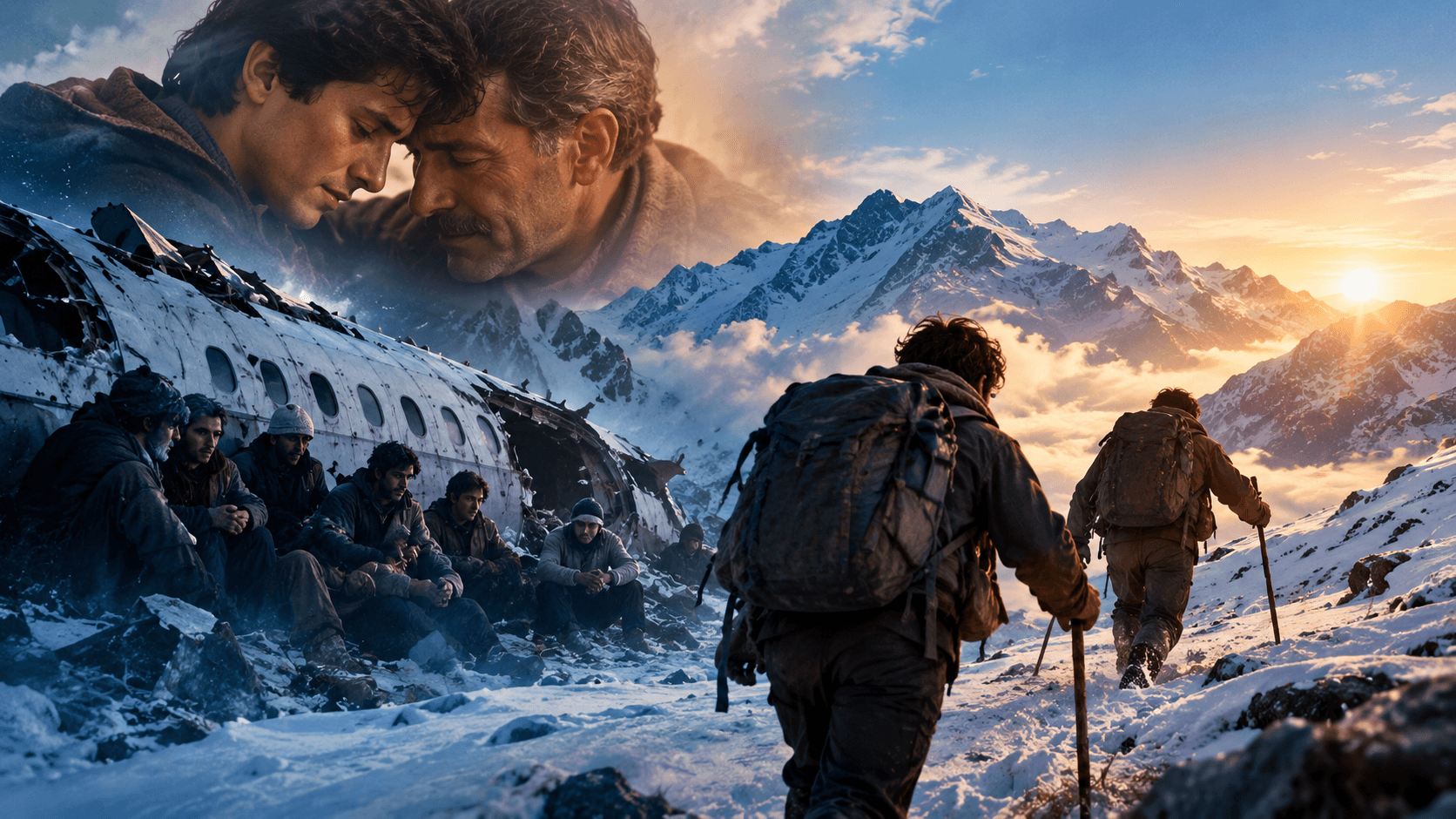
In October 1972, a plane carrying forty-five passengers, including members of the Uruguayan rugby team Old Christians, crashed deep in the Andes at roughly eleven thousand five hundred feet. The impact killed several passengers immediately, leaving survivors stranded on a remote glacier with no shelter, no winter equipment, and no way to call for help. They sheltered inside the broken fuselage, exposed to freezing cold and surrounded by an unforgiving landscape. For eight days they waited for rescue — until a transistor radio delivered the news that the search for the missing aircraft had been called off.
That moment changed everything. They were no longer waiting to be found. They had to face the possibility that no one was coming.
In the weeks that followed, the survivors endured conditions that tested every dimension of human resilience. An avalanche buried the fuselage and killed several more people. Parrado lost his mother in the crash, and soon after, his younger sister. Around him were teammates and fellow survivors carrying their own grief and fear. What stands out in this story is that survival did not come from individual strength alone — it came from relationships.
The survivors were bound by a social structure that existed long before the crash: friendship, family, teamwork, responsibility, and trust. They had been teammates before they became survivors, and they understood that staying alive was not a purely individual act — each person's survival was tied to the groups. This points to something fundamental in human bonding, perhaps inherited as a species: people survive because they have someone, or something, beyond themselves that gives life meaning.
For Parrado, that meaning was deeply personal. His thoughts kept returning to his father in Montevideo. He imagined walking back into his father's shop and seeing him again. He could not accept the idea of his father losing his entire family. His determination was about returning to a relationship — his father became a bridge between the world he had lost and the one he still hoped to reach.
This may be one of the deepest truths about resilience: human will grow strongest when survival is tied to purpose. People can endure extraordinary suffering when there is a reason to endure it. Purpose gives pain a direction, turning survival from a biological instinct into an emotional commitment. Studies on longevity echo this — beyond socioeconomic and health factors, a strong sense of purpose is closely linked to a long life. That same principle seems to hold even in the most extreme circumstances.
After nearly two months at the crash site, Parrado and teammate Roberto Canessa realized that waiting was no longer an option. With almost no equipment, they improvised what gear they could and set out west across the mountains in search of help. The journey was physically overwhelming. Faced with endless stretches of snow, the two men briefly lost their sense of direction — one of the most dangerous things that can happen in high-altitude terrain. But after ten days of travel, they encountered a Chilean traveller, whose help led rescuers back to the fourteen survivors still waiting at the crash site after seventy-two days.
Parrado's story challenges the idea that resilience belongs only to exceptionally strong individuals. Human beings are social creatures, and even in total isolation, our identities remain tied to others — as sons and daughters, friends, teammates, and members of communities. These relationships create the meaning that can keep us moving when everything material has been stripped away.
This is perhaps why the will to survive resists pure logic. Logic can calculate probabilities, resources, and risks — and tell us when things are hopeless. But the will to survive is driven by things far harder to measure: love, responsibility, memory, belonging, and the belief that somewhere beyond the present moment, a life still worth returning to exists.
Ultimately, Parrado's story reminds us that resilience isn't fearlessness or grand courage. It is the simple decision to take another step, to lean on the people around us, and to remember why the journey matters. Human will be strengthened by meaning — and meaning is built through connection. When the mountain seems impossible, resilience may be nothing more, and nothing less, than answering that call and refusing to stop.
Resilience, Purpose, and the Story of Nando Parrado
During moments of hardship, the line between giving up and pressing forward rarely comes down to skill or resources. It comes down to resilience. True resilience is not merely the ability to withstand pressure; it is the capacity to endure severe adversity, adapt to seemingly impossible conditions, and keep moving forward when every rational indicator suggests hope is lost. Few stories illustrate this better.
In October 1972, a plane carrying forty-five passengers, including members of the Uruguayan rugby team Old Christians, crashed deep in the Andes at roughly eleven thousand five hundred feet. The impact killed several passengers immediately, leaving survivors stranded on a remote glacier with no shelter, no winter equipment, and no way to call for help. They sheltered inside the broken fuselage, exposed to freezing cold and surrounded by an unforgiving landscape. For eight days they waited for rescue — until a transistor radio delivered the news that the search for the missing aircraft had been called off.
That moment changed everything. They were no longer waiting to be found. They had to face the possibility that no one was coming.
In the weeks that followed, the survivors endured conditions that tested every dimension of human resilience. An avalanche buried the fuselage and killed several more people. Parrado lost his mother in the crash, and soon after, his younger sister. Around him were teammates and fellow survivors carrying their own grief and fear. What stands out in this story is that survival did not come from individual strength alone — it came from relationships.
The survivors were bound by a social structure that existed long before the crash: friendship, family, teamwork, responsibility, and trust. They had been teammates before they became survivors, and they understood that staying alive was not a purely individual act — each person's survival was tied to the groups. This points to something fundamental in human bonding, perhaps inherited as a species: people survive because they have someone, or something, beyond themselves that gives life meaning.
For Parrado, that meaning was deeply personal. His thoughts kept returning to his father in Montevideo. He imagined walking back into his father's shop and seeing him again. He could not accept the idea of his father losing his entire family. His determination was about returning to a relationship — his father became a bridge between the world he had lost and the one he still hoped to reach.
This may be one of the deepest truths about resilience: human will grow strongest when survival is tied to purpose. People can endure extraordinary suffering when there is a reason to endure it. Purpose gives pain a direction, turning survival from a biological instinct into an emotional commitment. Studies on longevity echo this — beyond socioeconomic and health factors, a strong sense of purpose is closely linked to a long life. That same principle seems to hold even in the most extreme circumstances.
After nearly two months at the crash site, Parrado and teammate Roberto Canessa realized that waiting was no longer an option. With almost no equipment, they improvised what gear they could and set out west across the mountains in search of help. The journey was physically overwhelming. Faced with endless stretches of snow, the two men briefly lost their sense of direction — one of the most dangerous things that can happen in high-altitude terrain. But after ten days of travel, they encountered a Chilean traveller, whose help led rescuers back to the fourteen survivors still waiting at the crash site after seventy-two days.
Parrado's story challenges the idea that resilience belongs only to exceptionally strong individuals. Human beings are social creatures, and even in total isolation, our identities remain tied to others — as sons and daughters, friends, teammates, and members of communities. These relationships create the meaning that can keep us moving when everything material has been stripped away.
This is perhaps why the will to survive resists pure logic. Logic can calculate probabilities, resources, and risks — and tell us when things are hopeless. But the will to survive is driven by things far harder to measure: love, responsibility, memory, belonging, and the belief that somewhere beyond the present moment, a life still worth returning to exists.
Ultimately, Parrado's story reminds us that resilience isn't fearlessness or grand courage. It is the simple decision to take another step, to lean on the people around us, and to remember why the journey matters. Human will be strengthened by meaning — and meaning is built through connection. When the mountain seems impossible, resilience may be nothing more, and nothing less, than answering that call and refusing to stop.