The Frozen Researcher: Why Indian Teachers Want to Research but Can't
"The Frozen Researcher: Why Indian Teachers Want to Research but Can't"
- Dr. N.Ramkumar, Head, Teacher Professional Excellence
Why are ten million teachers stuck between knowing and doing—and what will it take to turn classroom wisdom into practitioner research?
Picture a science teacher in a government school in rural Uttar Pradesh. She has been teaching for fourteen years. Every single day, she watches which explanations click and which ones fall flat. She notices that her students grasp fractions far better when she provides real-life examples than when she writes numbers on a board. She quietly changes her approach, watches the room come alive, and stores the insight in her memory — where it stays. Nobody else ever knows. The next year, a colleague in the same school makes the same discovery from scratch....
This is not a story about one teacher. It is the story of ten million of them.
What we found
The Prayoga Institute of Education Research recently completed a national study — the largest qualitative study of its kind - engaging 306 teachers and administrators from government and private schools across ten Indian states, through 59 online Focus Group Discussions. We wanted to understand a single, pressing question: What does it actually take for a teacher in India to become a teacher-researcher?
What we found was both surprising and deeply troubling. Indian teachers are not reluctant researchers. They are enthusiastic about the idea of research. They believe in it, speak about it with conviction, and can articulate exactly why it matters. Ask a teacher in Bodoland, Maharashtra or Tamil Nadu what professional development should look like, and they will tell you without hesitation: equip us with research skills, teach us how to collect data and show us how to apply findings in class.
The problem is not belief. The problem is that the belief leads nowhere. We called this the Frozen Pattern — a condition in which strong professional conviction in the value of research coexists with minimal formal action. Teachers are not frozen because they do not care. They are frozen because the conditions that would allow them to act have never been created.
The four walls of the trap
Think of it as four walls, each one reinforcing the others.
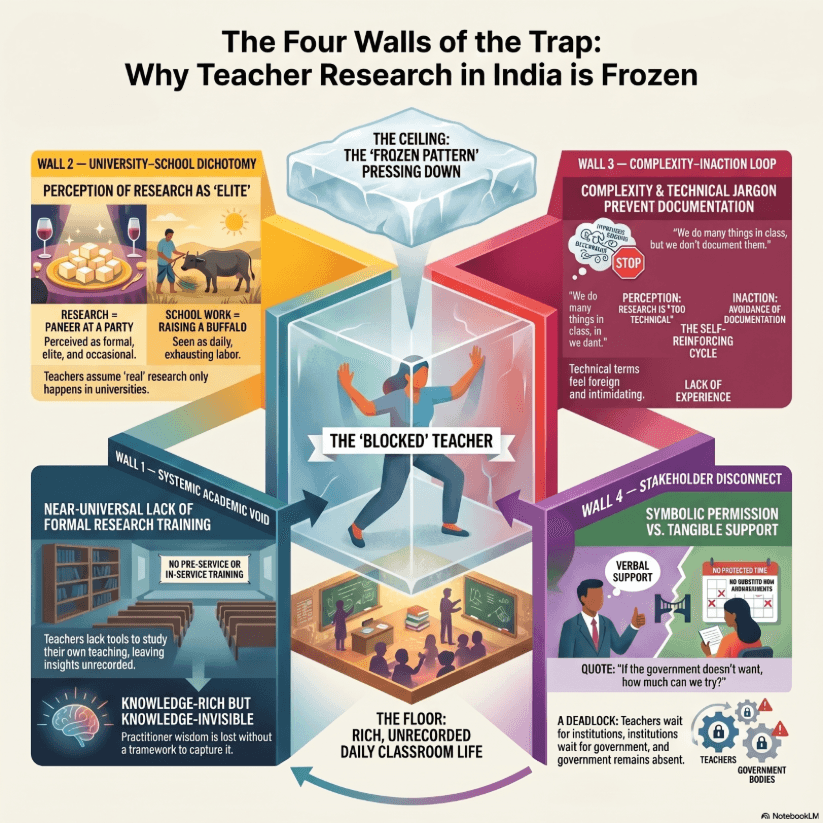
The first wall is what we call the Systemic Academic Void.
The majority of teachers in India receive no formal training in research during their initial teacher preparation or in-service professional development. As a result, teachers generate extraordinary practitioner wisdom daily but have no framework to capture, document or share it.
The second wall is the University–School Dichotomy.
Teachers have absorbed the assumption that research is something that happens in universities—formal, theoretical, frankly and intimidating. A government administrator from Uttar Pradesh put it memorably: university research is like eating paneer at a party—occasional, elevated and rather special—while school research is like raising a buffalo—daily, exhausting and essential, but never glamorous. Teachers sense that what they do matters. They simply cannot imagine it qualifying as research.
The third wall is the Complexity–Inaction Loop.
The moment a teacher thinks about formalising their classroom insights—writing them up, structuring them as a study—the perceived complexity of research methodology shuts the door. How do I frame a hypothesis? What counts as data? The questions feel technical and foreign, and because teachers have never been supported through the process, the complexity never diminishes. As one teacher from Uttar Pradesh put it simply: "We do many things in class, but we don't document them." That single sentence captures an enormous loss—not just for individual teachers, but for the entire profession.
The fourth wall is the Stakeholder Disconnect.
Government bodies are largely absent from the teacher-research ecosystem. SCERTs and district education authorities do not fund, mandate, or scaffold teacher inquiry. School administrators offer what we might call verbal permission — they are supportive in conversation but provide no protected time, no substitution arrangements, no formal recognition. As a school administrator from Mizoram told us, with unmistakable frustration: "If the government doesn't want, then on our own, how much we will try?" And so,teachers wait for institutional support that administrators do not consider their job to provide, while administrators wait for government direction that never arrives.
The irony at the heart of it
Here is what makes this particularly heartbreaking. India's National Education Policy 2020 explicitly envisions teachers as reflective practitioners and knowledge professionals for 21st century. It calls for fifty hours of Continuous Professional Development every year. It imagines a school system populated by teachers who inquire, adapt and grow.
The teachers we spoke to want exactly that. They are ready. Some of them are already doing it informally, intuitively and invisibly. A teacher in Mizoram described her daily practice as being like a doctor running lab tests — not something extraordinary, but something professionally necessary, something she does because it makes her better at her job. She just has no language, no platform and no recognition for what she is already doing.
What would actually help
The teachers in our study were remarkably clear about what they need. They need someone to walk alongside them — what teachers in Tamil Nadu called "handholding": a mentor who revisits with them, reads with them and helps them frame their observations into something shareable. They need time that is protected rather than colonised by census surveys and election duties. They need a platform — even a simple digital one — where a good lesson documented in a village school in Chhattisgarh can reach a teacher in Rajasthan who is facing the same problem.
What is at stake
India has 14.71 lakh schools and 24.69 crore students (UDISE, 2024). The quality of what happens in those schools depends, more than anything else, on the quality of the teachers in them. And the quality of teachers depends on whether the profession can learn from itself — whether the insight of a brilliant teacher in year fourteen gets passed on, built upon and scaled, rather than retiring quietly with her.
Right now, that knowledge is being lost every single day. Not through negligence, but through the absence of any system designed to hold it.
India's teachers are not reluctant researchers. They are frozen researchers — waiting, believing and ready — for a system that has not yet decided to meet them where they are.
It is long past time to unfreeze them.
This article is based on findings from a national needs analysis study conducted by the Prayoga Institute of Education Research, engaging 306 teachers and administrators across 10 Indian states.
Similar Blogs
News, Voices & Impact
Explore updates, field notes, and stories that showcase our mission and impact.